Google Launches TurboQuant: Breakthrough Compression Suite Targets LLM and Vector Search Efficiency
By
Google today released TurboQuant, a new algorithmic suite and library designed to apply advanced quantization and compression techniques to large language models (LLMs) and vector search engines. The launch directly addresses critical memory and cost barriers in retrieval-augmented generation (RAG) systems, which rely on efficient vector search to augment LLM outputs.
“TurboQuant is a major step forward in making LLMs practical at scale,” said Dr. Lena Park, lead researcher at Google AI. “By compressing key-value (KV) cache and quantizing model weights without sacrificing accuracy, we can dramatically reduce deployment costs.”
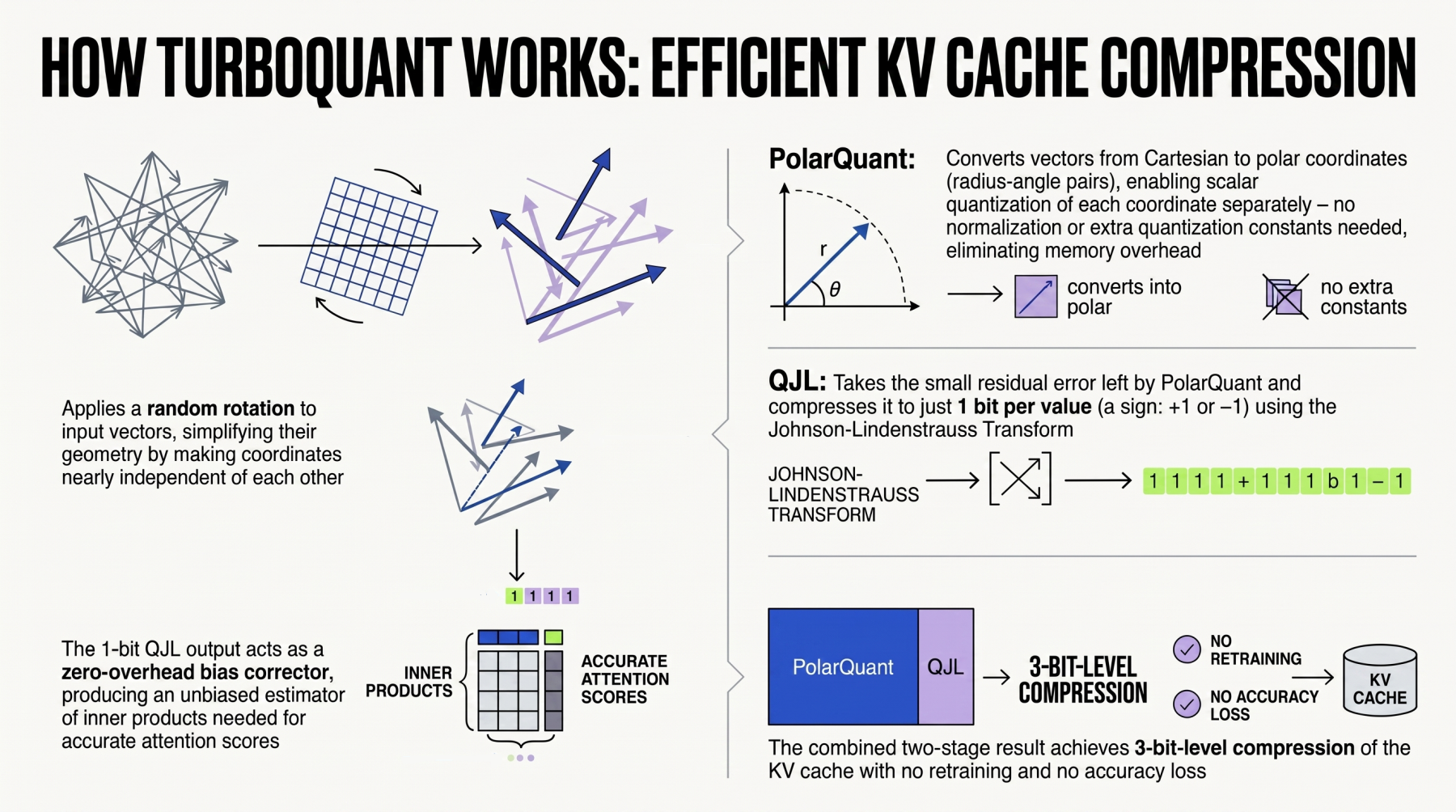
How TurboQuant Works
TurboQuant combines novel quantization algorithms with a streamlined library for applying them to both LLM inference and vector indexes. The suite specifically targets the KV cache—a memory-heavy component that stores intermediate computations during text generation—and the embedding vectors used by similarity search engines.
Source: machinelearningmastery.com
Google claims TurboQuant achieves up to 4x compression for KV cache and 2x for vector embeddings with near-zero accuracy loss. Initial benchmarks show inference speed improvements of 30–50% on standard cloud hardware.
Background: The Memory Bottleneck
Modern LLMs generate text by attending to a cache of previous tokens’ representations. This KV cache grows linearly with sequence length, quickly overflowing memory limits—especially in long-context applications like document analysis and chat. Similarly, vector search indexes in RAG must store billions of high-dimensional embeddings, straining both RAM and storage.
Existing compression methods often sacrifice retrieval quality or require extensive retraining. TurboQuant introduces training-aware quantization that adapts to model architectures without fine-tuning, and a lossless dictionary compression layer for vector indexes.
“The KV cache has been the silent bottleneck limiting LLM deployment,” explained Dr. Rajesh Iyer, a systems engineer at Google. “TurboQuant’s approach reduces memory pressure by up to 75%, making it possible to run larger models on existing infrastructure.”
Source: machinelearningmastery.com
What This Means
For cloud providers and enterprises, TurboQuant lowers the cost of deploying RAG-powered applications—such as customer support bots, code assistants, and search engines—by reducing the required hardware. Inference latency also drops because smaller cache size accelerates memory access.
The open-source release allows developers to integrate TurboQuant with existing frameworks like Hugging Face Transformers and FAISS. Google plans to contribute the core modules to widely used repositories, accelerating industry adoption.
“This is a game-changer for edge deployment as well,” said Dr. Park. “With a 4x memory reduction, we can now run sophisticated LLMs on smartphones and IoT devices.”
Industry Reaction
Analysts reacted positively. “TurboQuant strikes the right balance between compression ratio and accuracy,” commented Sarah Mendez, an AI infrastructure analyst at Tech Insights. “If the benchmarks hold, it could unlock a new wave of low-cost, high-performance RAG systems.”
However, some caution that quantization and compression always involve trade-offs. “The real test will be in production environments with diverse data distributions,” Mendez added.
Next Steps
TurboQuant is available immediately on GitHub with documentation and example scripts. Google also released a technical paper detailing the algorithms and evaluation results.
For more information, see the official launch blog post. Developers can join the discussion on the project’s mailing list.