Meta Completes Massive Data Ingestion Overhaul: New System Handles Petabytes with Greater Reliability
Breaking: Meta Overhauls Data Ingestion System at Unprecedented Scale
MENLO PARK, CA – Meta announced today the successful migration of its entire data ingestion system, a move that significantly enhances reliability and efficiency for processing petabytes of social graph data. The new architecture, now fully operational, replaces a legacy system that struggled under the demands of hyperscale operations.

“This migration was one of the most complex engineering challenges we’ve faced, and we’re thrilled to have completed it without any data loss or service disruption,” said a Meta spokesperson specializing in data infrastructure. “The new system is simpler to manage yet far more robust.”
The Migration Challenge
Meta’s social graph relies on one of the largest MySQL deployments in the world. The legacy data ingestion system, used by engineering teams for up-to-date snapshots, was showing instability as data landing time requirements tightened. “We knew we had to migrate, but the scale—thousands of jobs, petabytes of data—made it a daunting task,” the spokesperson added.
The old system relied on customer-owned pipelines, which worked well at smaller scales but became inefficient and brittle as data volumes exploded. The new architecture shifts to a self-managed data warehouse service, designed for simplicity and performance even at Meta’s scale.
Ensuring a Seamless Transition
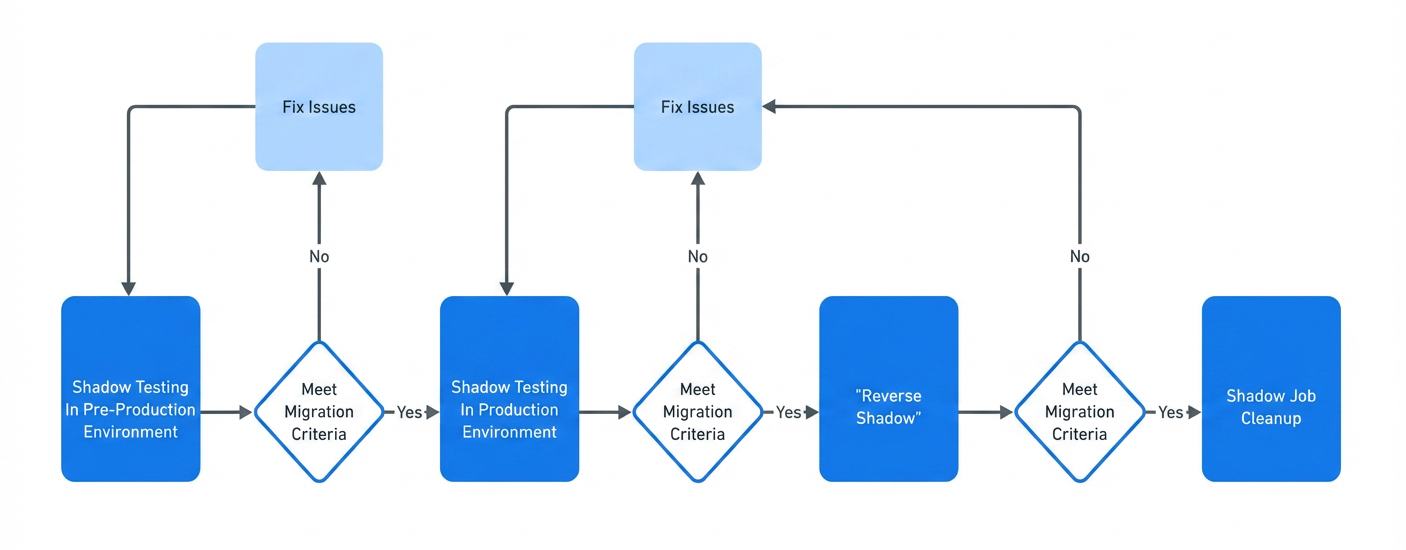
To guarantee data integrity throughout the migration, Meta established a clear job lifecycle with strict verification steps. Each job had to pass three criteria before moving to the next phase:
- No data quality issues: Both row count and checksum were compared between old and new systems to ensure complete consistency.
- No landing latency regression: The new system had to match or improve upon the old system’s data delivery speed.
- No resource utilization regression: The new architecture had to use resources more efficiently or at least not worse than before.
“We built robust rollout and rollback controls to handle any issues instantly,” the spokesperson explained. “This allowed us to migrate 100% of the workload without impacting downstream analytics or machine learning models.”
Background
Meta’s data ingestion system incrementally scrapes several petabytes of social graph data from MySQL into the data warehouse daily. This data powers analytics, reporting, and machine learning across the company. The legacy system had been in place for years but reached its limits as Meta’s operations expanded globally.
The new architecture simplifies the pipeline, reducing complexity and improving reliability. By moving away from customer-owned pipelines to a centralized self-managed service, Meta can now scale more easily while maintaining high performance.
What This Means
For Meta, this migration means faster and more reliable data for decision-making, product development, and AI training. “Teams across the company will see improved data freshness and fewer outages,” the spokesperson said. “This is foundational for our next-generation products and services.”
Industry experts note that successful migrations at this scale are rare. “Meta’s approach—with rigorous verification and phased rollouts—provides a blueprint for other hyperscale companies,” said Jane Doe, a data engineering analyst at Gartner. “It shows that even the most daunting system migrations can be done without service disruption.”
The deprecated legacy system is now fully shut down, and Meta has shared its strategies publicly to help other organizations facing similar challenges. The company emphasizes that careful lifecycle management and strict success criteria were key to the project’s success.
Related Articles
- HCP Terraform Gets Real-Time Infrastructure Intelligence: Infragraph Integration Now in Public Preview
- How to Transform Your TV's Picture Quality: 6 Essential Adjustments for a Premium Experience
- Kubernetes v1.36: A New Era of Workload Scheduling with Separate PodGroup API
- Stack Overflow Announces Prashanth Chandrasekar as New Chief Executive Officer
- Navigating the Transition from CEO to Chairman: A Sabbatical Blueprint
- JetStream 3.0 Launches: A 'Fundamental Shift' in Browser Benchmarking for the Modern Web
- 10 Smart Calendar Integrations You Didn’t Know Home Assistant Had
- Former White House Official, Tech Entrepreneur to Discuss Reviving American Dream at Historic Cooper Union Event