Accelerating JSON.stringify: Under the Hood of V8's 2x Speed Boost
Introduction
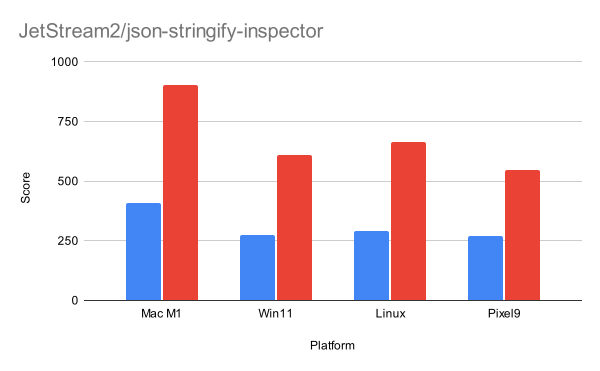
Every time a JavaScript application sends data to a server, saves user preferences to localStorage, or communicates between web workers, JSON.stringify is likely at work. This core serialization function transforms JavaScript objects into JSON strings—a task so common that its performance directly impacts user experience. A faster JSON.stringify means quicker page loads, snappier interactions, and more responsive apps. That’s why a recent optimization in the V8 JavaScript engine has generated excitement: our team managed to make JSON.stringify more than twice as fast. In this article, we’ll dive into the technical innovations behind this achievement.
The Key Insight: A Side-Effect-Free Fast Path
At the heart of the optimization lies a simple yet powerful concept: if the engine can guarantee that serializing an object will not produce any side effects, it can bypass the cautious, general-purpose serializer and use a specialized, high-speed implementation. A side effect in this context refers to anything that disrupts the straightforward, linear traversal of the object graph. This includes not only obvious triggers like user-defined toJSON() methods or getters, but also subtler internal operations that might force a garbage collection cycle. As long as V8 can detect that the serialization is pure (no side effects), it stays on this fast path.
For a deeper understanding of what constitutes a side effect and how you can structure your code to avoid them, see the Limitations section.
Iterative Instead of Recursive
Another architectural shift in the fast path is the move from a recursive to an iterative traversal. The general-purpose serializer uses recursion, which adds overhead for stack checks and can lead to stack overflows with deeply nested objects. The new iterative approach eliminates these concerns entirely. It not only removes the need for stack overflow checks but also allows the engine to quickly resume processing after encoding changes (e.g., when switching between object types). Developers can now serialize significantly deeper nested object graphs without hitting recursion limits—a welcome improvement for complex data structures.
Handling String Encodings for Maximum Efficiency
Strings in V8 can be stored in two formats: one-byte (for pure ASCII characters) and two-byte (for Unicode characters outside the ASCII range). If a string contains even a single non-ASCII character, V8 expands the entire string to two-byte encoding, effectively doubling memory usage. This distinction has a direct impact on serialization performance because the serializer must handle both types.
Templatized Serialization Paths
To avoid constant branching and type checks in a single, unified implementation, the entire stringifier is now templatized on the character type. This means V8 compiles two separate, specialized serializer versions: one optimized for one-byte strings and another for two-byte strings. While this approach increases the engine’s binary size, the performance gains are well worth it. Each version is streamlined for its specific encoding, eliminating unnecessary checks and leveraging CPU-level optimizations.
Efficient Handling of Mixed Encodings
During serialization, the engine must inspect each string’s instance type to detect representations that cannot be handled on the fast path—for example, a ConsString (a concatenated string that might trigger a garbage collection during flattening). When such a string is encountered, V8 falls back to the slower, general-purpose serialization path for that element. This necessary check is also optimized: by integrating it into the templatized design, the engine ensures that the fast path remains as lean as possible for the majority of inputs.
Overall Impact and Future Directions
The combination of a side-effect-free fast path and specialized string handling has yielded a more-than-double speed improvement for JSON.stringify across typical workloads. Developers writing plain data objects (the most common use case) will see the greatest benefit. Additionally, the iterative architecture opens the door to even deeper nesting without errors.
While this optimization is already available in recent V8 builds, we continue to explore further refinements—such as smarter detection of side-effect-free contexts and more efficient handling of edge cases. The goal is to make the fast path applicable to an even broader range of real-world code.
Limitations and Considerations
The fast path is disabled if V8 detects any user-defined toJSON() methods, getters, or other potential side effects. Additionally, objects with undefined values, functions, or symbols as property values will not trigger the fast path because these require special handling. For best performance, stick to simple, plain objects containing only strings, numbers, booleans, null, arrays, and other plain objects.
Related Articles
- Creating Zigzag CSS Layouts: The Grid + Transform Method
- Mastering Diff Line Performance: A Step-by-Step Optimization Guide
- Accelerating JavaScript Startup in V8: A Guide to Explicit Compile Hints
- AI Agent Revolution: New Protocol Slashes Token Costs by 90% for Web Navigation
- Mastering CSS rotateY(): A Guide to 3D Horizontal Rotation
- 5 Ways GitHub Supercharged Pull Request Performance
- Revolutionary Browser-Based Testing Eliminates Node Dependency for Vue Components
- Mastering Markdown Components in Astro: A Q&A Guide