7 Intriguing Revelations About the Puzzling Galaxy NGC 1266
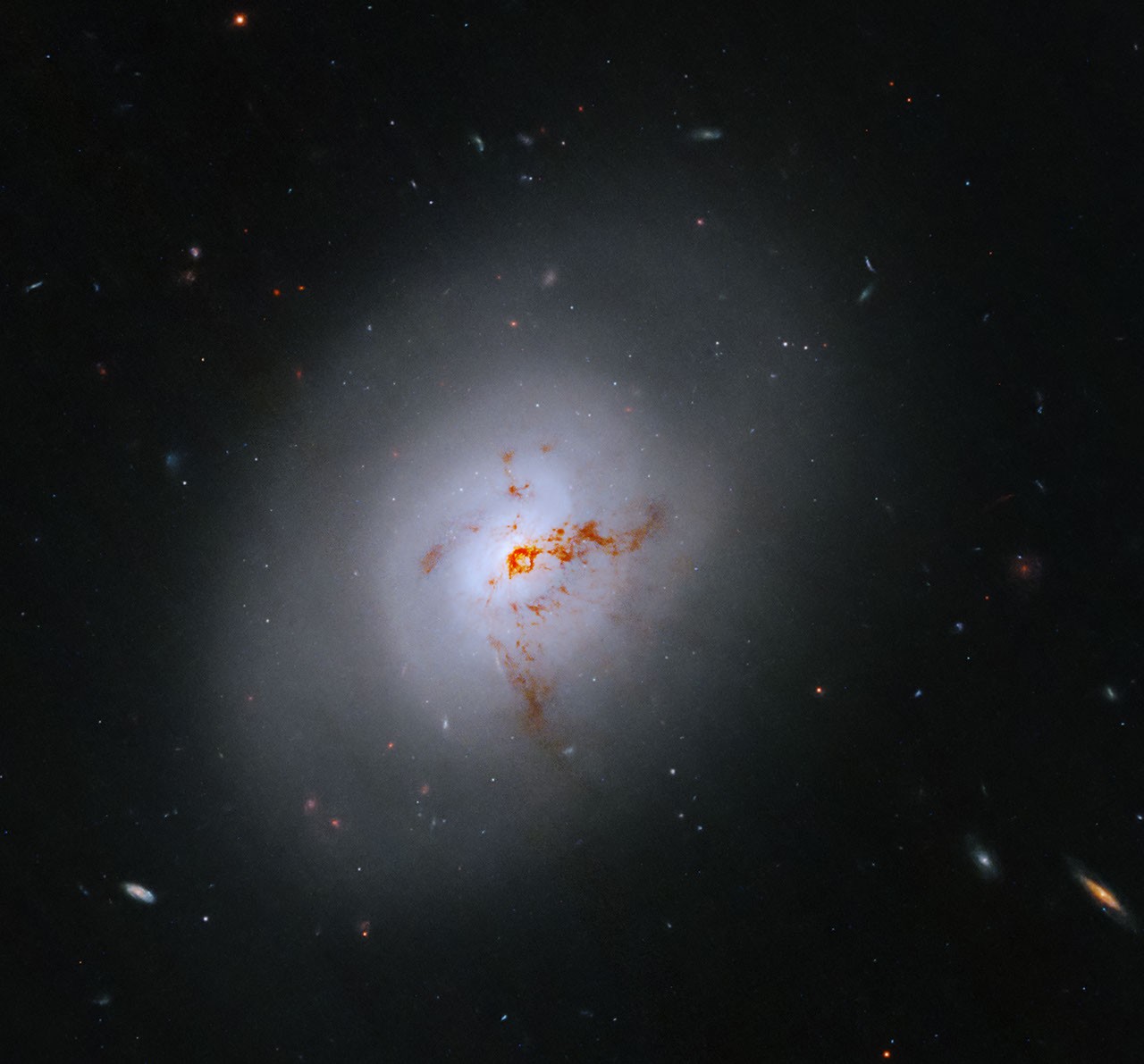
This NASA/ESA Hubble Space Telescope image reveals the lenticular galaxy NGC 1266, a captivating object that sits about 100 million light-years away in the constellation Eridanus. With a bright core, hints of spiral structure, but no clear arms, this galaxy is a cosmic puzzle. Dive into these seven facts that unravel its secrets and show how it helps astronomers understand galactic evolution.
1. A Lenticular Galaxy with a Mysterious Face
NGC 1266 is classified as a lenticular galaxy, a type that appears lens-shaped and combines features of both spirals and ellipticals. In the Hubble image, it shows a bright, concentrated center and a disk that hints at hidden spiral arms—but those arms never materialize. Instead, reddish-brown dust filaments and clumps partially veil the galaxy’s disk, while distant galaxies in red, blue, and orange shine through its diffuse outer regions. This enigmatic face sets the stage for deeper exploration.
2. The Cosmic Bridge Between Spiral and Elliptical
Lenticular galaxies like NGC 1266 are thought to be an evolutionary bridge. They possess a central bulge and a flattened disk, reminiscent of spirals, but lack spiral arms and have little to no ongoing star formation—similar to ellipticals. Astronomers believe that lenticulars form when spiral galaxies lose their gas and dust, or through mergers that disrupt their structure. NGC 1266’s classification gives scientists a unique vantage point to study this transition in real time.
3. A Rare Post-Starburst Phase
NGC 1266 is a post-starburst galaxy, a rare category that makes up only about 1% of local galaxies. Post-starburst galaxies experienced a major burst of star formation in the past but now have very few star-forming regions. Despite the lack of new stellar births, they host a young population of stars—remnants of that ancient frenzy. This suggests that NGC 1266 is in a quiet period after a dramatic episode, gradually settling into a more elliptical-like state.
4. A Minor Merger That Sparked Change
About 500 million years ago, NGC 1266 underwent a minor merger with another galaxy. This collision didn’t drastically reshape the galaxy but was enough to trigger a wave of new star formation and funnel gas into its central regions. The merger also increased the mass of the galaxy’s central bulge, a key step in its transformation. Such events are common in galactic evolution, but NGC 1266 offers a relatively recent example.
5. An Awakened Supermassive Black Hole
The gas funneled into the galaxy’s core didn’t just fuel stars—it also fed the supermassive black hole at the center. This influx of matter created an active galactic nucleus (AGN), making the black hole much more luminous and energetic. AGNs are powerful engines that can influence their host galaxy’s evolution by heating gas and regulating star formation. NGC 1266’s active core is a vivid example of this feedback loop.
6. Dusty Cobwebs and a Missing Spiral Structure
One of the most striking visual features of NGC 1266 is the intricate network of dust lanes. These reddish-brown filaments twist across the galaxy’s face, obscuring parts of the stellar disk. Unlike typical spiral galaxies, there are no defined arms—just a smooth, lens-shaped glow. The dust is likely leftover from the merger, and its distribution offers clues about how gas moves in transitional galaxies. The lack of clear spiral arms reinforces the galaxy’s lenticular nature.
7. A Glimpse into Our Galaxy’s Future?
Studying NGC 1266 helps astronomers understand what may happen to galaxies like our own Milky Way. Over billions of years, the Milky Way is expected to merge with the Andromeda Galaxy, eventually forming a lenticular or elliptical galaxy. By observing NGC 1266 in its post-starburst, transitional phase, scientists can test models of galaxy evolution and predict the fate of our cosmic home. This little galaxy serves as a time capsule for the future of the universe.
Conclusion
NGC 1266 is more than just a beautiful Hubble image—it’s a laboratory for studying galactic transformation. From its lenticular shape and post-starburst status to the merger that reshaped it, every detail tells a story of cosmic change. As Hubble continues to capture such objects, we piece together the grand narrative of how galaxies live, evolve, and eventually grow old.
Related Articles
- Space Force Accelerates Golden Dome Program: Orbital Missile Interceptors Targeted for 2028 Demo
- 8 Critical Ways Biological Invasions Impact Animal Welfare – And How We Measure Them
- Starship V3: A New Dawn for Lunar and Martian Exploration
- How to Understand the Causes of Lightning: A Step-by-Step Guide
- 10 Surprising Ways Squid and Cuttlefish Outlived the Dinosaurs
- Inside the $573M Interconnected Finances of Elon Musk's Companies
- New Tool Pinpoints Which AI Agent Crashed the Mission: Researchers Unveil 'Who & When' Dataset to Debug Multi-Agent Failures
- Deep-Sea Hideout: How Squid Outlasted Mass Extinctions Revealed in New Genomic Study