Unveiling the Magic: How Spotify Wrapped 2025 Turns Your Listening Data into Stories
Every year, Spotify Wrapped dazzles millions by transforming raw listening data into a personalized journey through your musical year. But how does Spotify pinpoint those “interesting listening moments” and weave them into a compelling story? Behind the scenes, a sophisticated blend of machine learning, data engineering, and creative storytelling brings your 2025 highlights to life. Below, we answer the most pressing questions about the technology that powers this annual phenomenon.
1. How does Spotify identify your top songs and artists for Wrapped 2025?
Spotify analyzes your entire year of listening data, from January 1 to October 31, to calculate your top songs and artists. The algorithm weighs play count, listening duration, and recency—giving a slight boost to tracks you discovered later in the year. But it’s not just about numbers; the system also looks for signal vs. noise. For example, a song you played on repeat for a week but never revisited might not make the cut. Instead, Wrapped prioritizes consistent listening patterns that reflect genuine affinity. To avoid bias from background or sleep playlists, the model filters out tracks with abnormally long streams or repetitive loops. This ensures your top picks truly represent the music that defined your year.
2. What specific data points does Spotify analyze to create your Wrapped story?
Wrapped draws from a rich set of listening signals: skipped tracks, saved songs, playlist additions, repeat listens, and sharing actions. It also examines listening sessions—when you tune in (morning commute, late-night wind-down) and for how long. For 2025, Spotify introduced contextual metadata, such as genre tags, mood annotations, and song popularity trends. This allows the system to detect “interesting moments” like a sudden shift in genre over a few weeks or a track you discovered right before it blew up. The algorithm then groups these patterns into narrative arcs—your “audio day,” your “breakout artist,” or your “year in genres.” All data is processed anonymously, with user-level aggregation occurring only after privacy safeguards are applied.
3. How does Spotify ensure user privacy while building your Wrapped?
Privacy is baked into the Wrapped pipeline from the start. Spotify uses differential privacy techniques—adding statistical noise to aggregate data so no individual’s listening can be reverse-engineered. For personal Wrapped cards, the system only accesses your own data, never cross-referencing it with others. Engineers also apply data minimization: they extract only the features needed for the story (e.g., top genres, total minutes) and discard raw event logs after processing. Additionally, all computations occur in isolated environments with strict access controls. Users can choose to opt out of certain data uses in their account settings, and Wrapped still works—just with less personalized insights. The result is a feature that feels intimate without compromising your digital footprint.
4. What role do machine learning models play in generating your Wrapped story?
Machine learning is the engine that turns raw logs into coherent narratives. One key model is a recurrent neural network (RNN) that identifies listening patterns over time—like a “summer anthem” you revisited every weekend. Another is a clustering algorithm that groups songs into mood or activity sessions (e.g., “workout energy” vs. “chill vibes”). For 2025, Spotify introduced a transformer-based language model that generates the short descriptions (like “You were way ahead of the curve on this one”) by analyzing millions of historical Wrapped reactions. This model is fine-tuned to be playful, empathetic, and concise. All predictions are logged and reviewed by humans to avoid biases or offensive phrasing. The final story is a fusion of data-driven facts and machine-authored commentary, balanced to feel authentic.
5. How does Wrapped 2025 handle genre diversity and niche tastes?
To celebrate every listener, Wrapped 2025 uses a multi-label genre classifier that assigns up to five genres per track, even for obscure or emerging sounds. This prevents the system from defaulting to “pop” when a user listens to hyperpop, k-pop, and lo-fi hip hop. The story engine then highlights your most distinct genre—the one that sets you apart from the average listener. For example, if you streamed 60% jazz and 40% electronic, it might spotlight “Your Jazz Renaissance.” Additionally, the algorithm detects taste elasticity: it notes when you ventured into a new genre and how quickly you adopted it. This allows Wrapped to surprise you with moments like “You discovered folk music in August—and never looked back.” The system is trained on a global catalog covering hundreds of micro-genres, ensuring no niche fandom is overlooked.

6. How does Spotify choose your “audio day” or “listening moments” for the story reel?
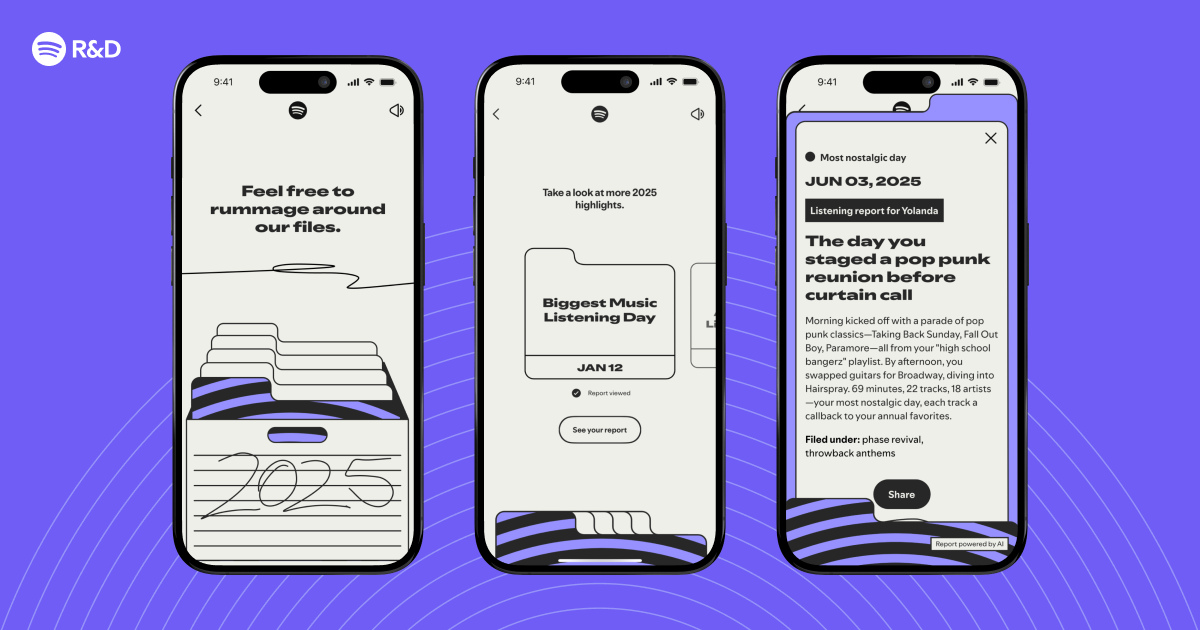
The “audio day” feature selects moments that exhibit high engagement combined with contextual uniqueness. The algorithm scans your entire year for sessions where you listened to a song multiple times in a short span, or where your listening dramatically shifted (e.g., from slow ballads to upbeat dance). It then cross-references timestamps with public data (like concert dates or holiday seasons) to infer context. For instance, if you played “All I Want for Christmas Is You” 15 times on December 24, that’s flagged as a “moment.” The story reel ranks these moments by surprise and delight—not just raw count. A single play of a song that later became a global hit might rank higher than a repeat of your usual favorites. This ensures the reel feels like a journey, not a statistics dump.
7. What technological innovations made their debut in Wrapped 2025?
Wrapped 2025 introduced real-time story rendering—your personalized slides are generated in milliseconds as you open the feature, using a serverless architecture that scales to millions of concurrent views. Another innovation is cross-platform context: if you listened on a smart speaker during a party, Wrapped can recognize that as a “social listening event” (without identifying who was present). Under the hood, Spotify deployed a graph database to map relationships between songs, artists, and your listening sessions, enabling richer connections like “You listened to this song because it was sampled in a track you already loved.” Lastly, the team introduced an AI narrator (optional) that reads your Wrapped aloud using a synthetic voice trained on thousands of hours of podcast speech. These advances make the experience faster, deeper, and more interactive than ever before.
8. How does Spotify test and iterate on the Wrapped experience each year?
Spotify runs an extensive A/B testing pipeline months before launch. A small percentage of users see experimental story formats—like a timeline view or a “musical DNA” chart—and their engagement metrics (shares, replays, time spent) are compared to the control group. Engineers also conduct qualitative interviews with diverse user segments to catch cultural blind spots. For 2025, feedback from previous years led to a “skip this slide” button, allowing users to tailor their final shareable image. Behind the scenes, the team uses feature flagging to roll out new models incrementally, monitoring for unexpected bias or performance drops. Every improvement is grounded in data: if a suggested story moment gets high thumbs-down, it’s deprioritized next year. This iterative cycle ensures Wrapped evolves with user expectations while remaining delightfully surprising.
Related Articles
- Agentic Development Unpacked: Insights from the Spotify x Anthropic Live Event
- 5 Key Things About Amazon Prime Video's New Clips Feed: A Vertical Short-Form Video Experience
- Building Robust UIs for Real-Time Streaming Data
- 5 Key Insights into Apple's Drive for More F1 Content
- Mastering Hypertension Monitoring on Apple Watch with watchOS 26: A Complete Setup Guide
- Walmart’s Onn Google TV 4K Streaming Stick: The Affordable Chromecast Alternative That Delivers
- Streaming Sequels Dominate This Weekend: From Ready or Not 2 to Greenland 2
- How Spotify Wrapped 2025 Works: The Engineering Behind Your Year in Music