How NASA’s Psyche Spacecraft Captured Mars During Its Gravity Assist Maneuver: A Step-by-Step Guide
Introduction
In May 2026, NASA’s Psyche mission executed a critical gravity assist maneuver around Mars, using the planet’s gravity to boost its speed and fine-tune its trajectory toward asteroid Psyche. During this approach, the spacecraft captured a striking image of Mars from about 3 million miles (4.8 million kilometers) away. This guide breaks down the process into actionable steps, showing how the mission team planned, executed, and interpreted the observation. Whether you’re a space enthusiast or a budding mission planner, you’ll learn the key phases of this complex operation.
What You Need
- A spacecraft with a multispectral imager – Like Psyche’s instrument, capable of capturing images with panchromatic (broadband) and other filters.
- Precise trajectory data – Knowledge of the spacecraft’s orbit and the gravity assist window.
- Understanding of high-phase angle geometry – The spacecraft approaches Mars from an angle where the Sun is “above” both objects, creating a crescent view.
- Knowledge of Mars’ atmosphere – Dust and seasonal clouds affect brightness and scattering.
- Image calibration tools – Software to process raw data and correct for oversaturation.
- Mission timeline – Schedule of events leading to close approach.
Step-by-Step Process
Step 1: Plan the Gravity Assist and Imaging Schedule
Months before the flyby, the Psyche navigation and science teams compute the exact trajectory. The gravity assist on May 15, 2026 is designed to increase the spacecraft’s speed and adjust its path. Imaging is scheduled for early acquisition – here, on May 3 – to test the imager’s performance and capture data for calibration. The team decides to observe Mars from a high-phase angle, meaning the Sun is nearly behind the spacecraft, illuminating only a thin crescent of the planet.
Step 2: Approach Mars from the Correct Geometry
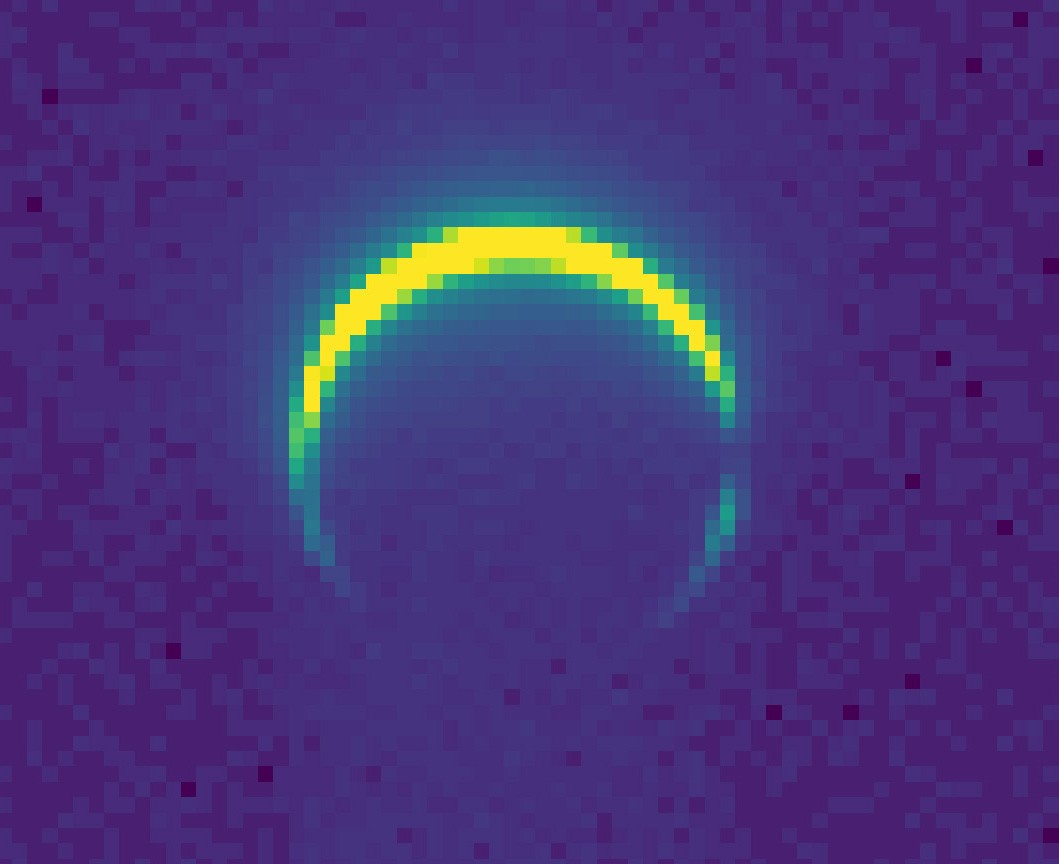
As the spacecraft nears Mars, it maintains a high-phase orientation. This results in Mars appearing as a slender crescent, similar to our Moon just after new Moon. The Sun is out of frame, positioned “above” both Mars and Psyche. This geometry minimizes direct glare and allows the imager to capture light reflected from the planet’s surface and atmosphere. The team monitors the approach distance – at the time of this image, Psyche is 3 million miles from Mars.
Step 3: Configure the Multispectral Imager
The imager is set to its panchromatic (broadband) filter, which captures a wide range of visible light. Because Mars’ crescent is extremely bright – sunlight reflecting off the surface and dust – the exposure time must be very short. The team chooses just 2 milliseconds. Even with this brief exposure, parts of the image can become oversaturated, meaning some pixels hit their maximum brightness. This is expected and helps characterize the camera’s dynamic range.
Step 4: Acquire the Image
On May 3, the spacecraft executes the observation command. The imager snaps the crescent Mars, capturing not only the illuminated surface but also sunlight scattered by dust particles in Mars’ atmosphere. Because the dust content varies rapidly, the predicted brightness is uncertain – this first image helps calibrate future predictions. The result is a colorized image (processed later) showing the thin crescent with an extended glow around the dark side.
Step 5: Process and Analyze the Raw Data
Back on Earth, the Psyche imager team receives the raw data. They apply calibration steps: subtract background, correct for sensor artifacts, and combine multiple filter exposures if needed. The Figure A zoomed-out view reveals no stars because they are much dimmer than the reflected sunlight. The team notes that the crescent is so bright that some areas are saturated, providing useful data on the camera’s limits. They also identify an interesting feature: on the right side of the extended crescent, there appears a gap. This coincides with Mars’ icy north polar cap, currently in winter. The team hypothesizes that seasonal clouds and hazes in that region block the dust’s ability to scatter sunlight, causing a dark patch.
Step 6: Use the Data for Calibration and Preparation for Asteroid Approach
The primary purpose of this image is not scientific discovery but instrument calibration. By imaging a well-known target (Mars) at a known distance, the team can refine the camera’s performance parameters – exposure accuracy, sensitivity, and saturation levels. This is a dress rehearsal for the eventual approach to asteroid Psyche in 2029. The team will acquire and process similar images in the days leading up to the May 15 close approach, continuously improving their models. The data also help predict how the imager will behave when imaging a much smaller, darker asteroid.
Tips for Success
- Plan for uncertainty: Mars’ atmospheric dust changes quickly, so build flexibility into exposure settings. Use early images to adjust later observations.
- Account for phase angle effects: High-phase angles reveal atmospheric scattering well but can cause oversaturation. Test multiple exposure times to balance brightness and detail.
- Watch for seasonal features: The north polar cap’s gap shows that seasonal clouds can disrupt scattering. Use historical Mars weather data to anticipate such effects.
- Calibrate early and often: Each image is a chance to validate camera performance. Use approach-phase images as a practice run for the main science target.
- Document everything: The gap anomaly led to a hypothesis about seasonal hazes – such observations can yield unexpected science rewards if recorded properly.
By following these steps, the Psyche mission successfully captured Mars during its gravity assist, setting the stage for a smooth journey to the asteroid belt. Learn more about the Psyche mission.
Related Articles
- Consciousness Could Be the Fundamental Fabric of Reality, New Theory Proposes
- Three Tech Trends Reshaping Our Future: IVF Innovations, Balcony Solar, and the Rise of AI Resistance
- Amateur Astronomer's Breathtaking Image Reveals Pleiades Cluster Shrouded in Icy Blue Nebula
- Rocket Industry Update: Starship, Blue Moon, and the Pentagon's Space Defense Initiative
- Revolutionizing Onboard Processing: NASA's Next-Generation Spaceflight Computer
- 7 Fascinating Facts About the Ucayali River Seen from Space
- How VECT Ransomware’s Fatal Design Flaw Turns It Into a Wiper: A Technical Walkthrough
- Your Ultimate Guide to Witnessing Spain's Rare Sunset Total Solar Eclipse from Secret Spots