Making Man Pages More User-Friendly: Lessons from Notable Examples
Man pages are the backbone of Unix-like system documentation, but they often suffer from poor navigability and dense formatting. After working extensively on the Git man pages, I found myself creating cheat sheets for tools like tcpdump, git, and dig because the official manuals were hard to parse for quick reference. This prompted a deeper question: could man pages themselves incorporate cheat-sheet-like elements to boost usability? I polled my Mastodon followers for their favorite man pages and discovered several innovative approaches that can transform a clunky reference into a streamlined tool.
The Quest for Better Man Page Design
Most man pages follow a rigid structure: NAME, SYNOPSIS, DESCRIPTION, OPTIONS, EXAMPLES, and SEE ALSO. While this framework ensures consistency, it often buries critical information under alphabetically sorted flags. The community’s feedback pointed to three standout features that make certain man pages shine: an OPTIONS SUMMARY, categorized flags, and built-in cheat sheets.
Feature 1: OPTIONS SUMMARY – The rsync Approach
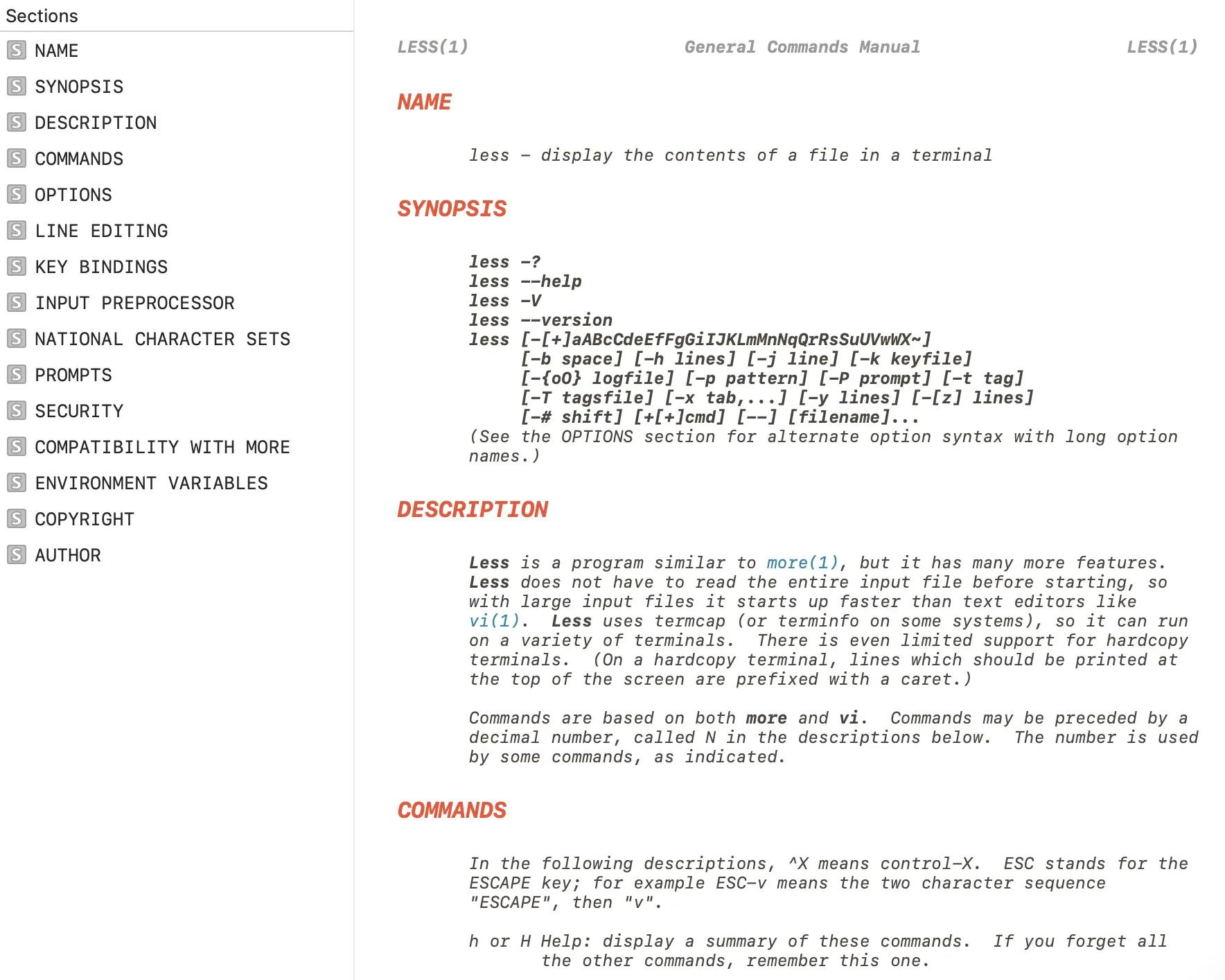
The rsync man page solves the infamous alphabet soup problem. Instead of cluttering the SYNOPSIS with dozens of single-letter flags like ls [-@ABCFGHILOPRSTUWabcdefghiklmnopqrstuvwxy1%,], it keeps the synopsis terse:
rsync [OPTION...] SRC... [DEST]Then, a dedicated OPTIONS SUMMARY section lists every option in a compact table with a one-line description:
- --verbose, -v – increase verbosity
- --info=FLAGS – fine-grained informational verbosity
- --debug=FLAGS – fine-grained debug verbosity
- --stderr=e|a|c – change stderr output mode (default: errors)
- --quiet, -q – suppress non-error messages
- --no-motd – suppress daemon-mode MOTD
Full details follow in the normal OPTIONS section. This dual-level approach gives users a quick overview without sacrificing depth.
Feature 2: Categorized Options – The strace Example
Another innovation comes from the strace man page, which groups its options into thematic categories: General, Startup, Tracing, Filtering, and Output Format. This organization contrasts sharply with the typical alphabetical list that forces readers to skim through irrelevant flags.
Curious about applying this to grep, I restructured its options into categories. While the result was useful, it also revealed a personal struggle: I could never remember the name of the -l flag (which prints only filenames containing matches). Decades of alphabetically sorted man pages had trained me to scan for “l” rather than think by function. A categorical layout might have shortened that search. It’s an experiment worth replicating, even if the ideal taxonomy takes trial and error.
Feature 3: Built-in Cheat Sheets – The perlcheat Model
The Perl documentation suite goes a step further with dedicated cheat-sheet man pages. man perlcheat delivers compact, 80-character-wide ASCII syntax summaries:
SYNTAX
foreach (LIST) { }     for (a;b;c) { }
while   (e) { }        until (e)   { }
if      (e) { } elsif (e) { } else { }
unless  (e) { } elsif (e) { } else { }
given   (e) { when (e) {} default { } }
This is a brilliant addition because it matches the mental model of experienced users who just need a syntax reminder, not a full tutorial. It also demonstrates how man pages can serve both deep reference and quick lookup simultaneously—something few other manuals achieve.
Conclusion: Toward Better Documentation
The humble man page doesn’t have to be a wall of text. By borrowing ideas from rsync (OPTIONS SUMMARY), strace (categorized options), and perlcheat (compact cheat sheet), we can create documentation that respects the reader’s time and cognitive load. These patterns are low-effort to implement yet yield significant improvements in usability.
Whether you maintain open source tools or write internal documentation, consider adding an options summary table, grouping flags by function, or even preparing a standalone cheat-sheet man page. Small changes can turn a frustrating reference into a powerful ally.
Related Articles
- Apple Raises Mac Mini Price: Entry-Level Model Discontinued Amid Chip Constraints
- Utah Enforces Landmark Law Making Websites Liable for VPN-Aided Age Verification Bypasses
- Spark Unveils Comprehensive Risk Framework for Sky Agent Network Amid Security Push
- Making Man Pages More User-Friendly: Insights and Innovations
- How to Enhance Man Pages with Practical Examples: A Guide for Tcpdump and Dig
- How a Hidden Bluetooth Tracker in a Postcard Exposed Naval Security Gaps
- 6G Wireless Future: Ten Breakthrough Technologies Set to Redefine Connectivity
- 10 Game-Changing Insights: How AI-Powered Penetration Testing Outpaces Manual Efforts