Unlocking Faster JSON Serialization: Inside V8's Double-Speed Optimization
Introduction
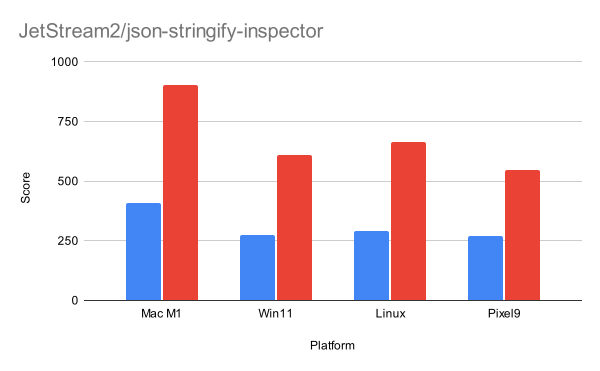
The JSON.stringify method is a cornerstone of JavaScript development, enabling quick conversion of objects into JSON strings for network requests, storage, and data exchange. Its performance directly impacts application responsiveness, making any speed improvement a notable win for developers. Recently, the V8 team achieved a breakthrough: JSON.stringify now runs more than twice as fast. This article explores the technical innovations behind this leap, focusing on a new streamlined path and optimized string handling.
The Side-Effect-Free Fast Path
The core of the optimization lies in a new fast path that activates when the serializer can guarantee that no side effects will occur during serialization. A side effect includes any action that deviates from simple object traversal, such as executing user-defined code or triggering garbage collection cycles. By avoiding these complexities, V8 can use a highly specialized serialization routine.
This fast path is iterative rather than recursive, eliminating stack overflow checks and allowing rapid recovery after encoding changes. As a result, developers can serialize deeply nested object graphs—even those that previously caused stack issues. The improvement is most significant for common plain-data objects, which now serialize with minimal overhead.
For a deeper understanding of what constitutes a side effect and how to avoid triggering the slow path, see the Limitations section.
Handling Different String Representations
V8 stores strings in two formats: one-byte (ASCII characters only, 1 byte per character) and two-byte (non-ASCII characters, doubling memory usage). The original serializer used branching logic to handle both, causing performance penalties.
The new approach templatizes the entire stringifier on character type, compiling two distinct, optimized versions: one for one-byte strings and another for two-byte strings. While this increases binary size, the performance gain justifies the trade-off.
During serialization, V8 inspects each string's instance type to detect representations that cannot be processed on the fast path (e.g., ConsString, which may trigger a GC during flattening). If such a string is found, it falls back to the slow path. This check is necessary and ensures correctness without sacrificing speed for the common case.
Limitations and Considerations
While the fast path delivers dramatic speedups, it only works when serialization is side-effect-free. Developers can maximize benefit by using plain objects without custom toJSON methods, getters, or symbol keys. Additionally, objects with deeply nested arrays or functions may still trigger the slow path. Understanding these boundaries helps in writing performance-sensitive serialization code.
Conclusion
V8's latest optimization for JSON.stringify demonstrates how careful architectural decisions—like isolating side-effect-free paths and specializing for string encodings—can yield major performance improvements. For JavaScript developers, this means faster data serialization out of the box, especially for typical plain-datastructures. As V8 continues to evolve, such targeted optimizations will further enhance web application speed and responsiveness.
Related Articles
- Mastering Markdown in Astro: A Comprehensive Guide
- Achieving Fast Diff Line Rendering: GitHub's Performance Overhaul for Pull Requests
- Revolutionary Aluminum Compound: 7 Ways It Could Transform Industry and Replace Rare Metals
- Block Protocol Aims to Fix Web's Semantic Struggles After 25 Years
- Breaking: Developers Battle 100+ WebSocket Events Per Second – Here’s How to Stop UI Lag
- V8 Update Doubles JSON.stringify Performance – What Developers Need to Know
- Breaking: Vue Component Testing Now Possible Directly in Browser, No Node.js Required
- Boosting JSON.stringify Performance: How V8 Achieved a 2x Speedup